Welcome back to the World of Astrom blog! Here I’m continuing my Races of Astrom series with a sequence of posts about the different Mortal people groups in Astrom. This follows on from previous posts about the elves, dwarves and armists.
***
After the recent introduction to the Mortals in Astrom generally, and after these portraits of the Mortals of Aranar, the Mortals of Ciricien and the Mortals of Hendar, this is the fourth in a series of posts looking at each race of Mortals in turn. Still to come are the Mortals of Hendar, Lurallan and Urunmar.
Alanai is a generic elven term meaning ‘south-folk’, and originally it referred to the elves of Kalimar who removed to live in Alanmar, the ‘south-realm’ (future Maristonia). However, by the end of the Second Chapter, when Alanmar had become Maristonia, the term Alanai began to be applied to another group further south, as far as south goes in Astrom.
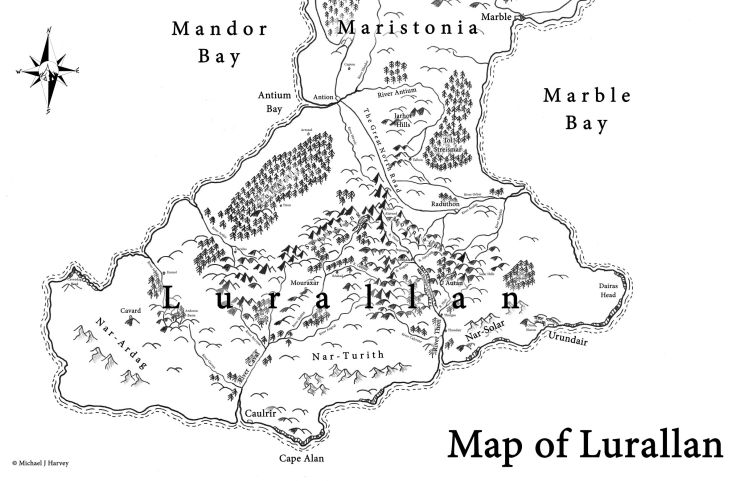
In the twenty-fifth century of the Second Chapter, elven mariners began to make permanent settlements on the arid coasts of southernmost Astrom. For centuries the Sea-elves had been sailing into these waters, long enough to know that there was an end to Astrom, and that past a certain point, Cape Alan, the land turned back northward towards Ithrill in the west. However, now they began to do more than camp on its beaches, they began to make permanent settlements. For the most part they were Sea-elves from Kalimar’s coastal region of Marinia, but to all who dwelt further north, these colonists became known as the Alanai, and their land was called Lurallan, ‘the extreme south’.
At first, they were merely thought strange for venturing into such inhospitable latitudes, and many also had a villainous reputation, coming as they did from the dregs of Kalimari society, but after the Great Betrayal, when the Curse of Morality visited even the southernmost shores of Astrom, the term Alanai became a pejorative one, conjuring images of mysterious heretics and buccaneers.
Yes, the Alanai became Mortal, like many other cultures in the north of Astrom, but they were never just a homogenous group. The Maristonians who dwelt in constant vigilance upon the borders of Lurallan understood some of the distinctions, especially after fighting off Alanai incursions in the Three Barbarian Wars, but even they did not have a full understanding of Alanai culture. Nor did the Silver Empire, despite occupying over half of Lurallan for centuries in the mid to late Third Chapter. Hot, dry and forbidding, Lurallan and its people remained a mystery to the rest of Astrom, but here is how they understood themselves.
Within Lurallan itself were many tribal groups and independent cities. Setting aside for now the dwarves and Sand-elves who lived among them at one time, the Alanai recognised four loose categories within their society: the Merchant princes, the Corsairs, the City-states of the interior and the Desert nomads. Let’s look at each group in turn.
Merchant princes
The Merchant princes dwelt on the eastern and western edges of Lurallan where they were best positioned to trade with the rest of Astrom. There was Raduthon in the east and Cavard in the west. Both were ruled by merchant oligarchs, by great banking and trading families who vied with each other in constant rivalry. Raduthon was the largest and wealthiest city in Lurallan and controlled other, smaller eastern cities like Soubon and Naron. Cavard, if not quite so wealthy, was still rich, enjoying a hegemony over lesser cities like Ezenol, Curulus and Arthad that was rarely challenged.
Raduthon had an exalted reputation as a place of great culture and learning, whose sophistication was even grudgingly recognised in Maristonia. Partly this was because of its proximity to Maristonia, with whom it had more interactions than any other Alanai realm, and partly because its trade brought both wealth and an influx of cultural influences from the rest of the continent.
Theirs was the most fertile land, where copious rivers flowed year-round and where the climate, although hot, was conducive to agriculture. They also possessed many natural resources and commodities that were prized everywhere else in Astrom. Most famous of these were the spices that were cultivated in great slave-worked plantations, but there were also resins, gums, dyes, precious stones, oil and hardwoods. As well as crops for her own consumption, Raduthon owned vast sugar plantations, supplying this coveted substance to Maristonia and beyond. Cavard did likewise, albeit on a smaller scale.
The Merchant princes traded with other Alanai tribes and city-states as well as with foreign kingdoms, but in Lurallan the Raduthites and Cavardites were thought of as over-wealthy, effete, decadent and little better than armists. Lying exposed on flat plains between the central mountains and the sea, just across the border rivers, Raduthon and Cavard formed a buffer zone between Maristonia and the rest of Lurallan, both culturally and militarily. Both Raduthon and Cavard lay close within Maristonia’s orbit, the only difference being that while the one looked east across the Troizon Ocean to Maristonia’s east and Kalimar and Ciricen, the other was linked with western Maristonia and Ithrill and Hendar across the Sapheil Ocean.
Corsairs
There were two great corsair cities, Urundair and Caulrir, both lying along Lurallan’s sun-bleached southern coast. They were a scourge upon the mercantile states to the north as much as to Maristonia, with whom they were more or less constantly at war, but they were tolerated by the city-states of the interior, for they controlled their access to the sea and the outside world.
Urundair lay on the south-eastern coast, about half-way between Dairas Head in the east and the Thon estuary in the south. There were other smaller ports on this desolate coast, but most of them were either swallowed up, destroyed or entirely subjugated by the Wave-Lords of Urundair, so much that this became known as the Urundai Coast. This was a wild and lawless strip of territory on the fringe of Nar-Solar, the easternmost of Lurallan’s three great deserts. Urundair controlled salt mines and spice farms in its hinterland, but everything else it acquired by piracy, robbing both the Raduthites and armist merchant ships. It was ruled by the Undaeri, also known as Wave-Lords, pirate-chieftains who gained their eminence through strength and ruthlessness and lost it to the scheming machinations of rivals and underlings. The Undaeri lived in sumptuous luxury with palaces and private harbours on the rocky Isle of Serenity in the city’s heart, but outside the Isle the rest of Urundair was a filthy, seething cauldron of chaotic trade and constant violence.
Caulrir lay to the west, beyond Cape Alan at the mouth of the River Caval. It made its fortune both from piracy and from controlling the trade that flowed down the Caval from the cities of the interior. The Caulriri were fierce rivals of the Undaeri, and their fleets often clashed off Cape Alan where they battled for dominance over the trade of the southern coasts. Just as frequently they were preying on merchant shipping further north, the Undaeri in Marble Bay and Dagger’s Cove and the Caulriri in Mandor Bay and Frontier Head, though neither ventured much further north very often. The Caulriri Wave-Lords were just as formidable and brutal as their Undaeri rivals, admirals of private fleets, slave-masters and robber barons all combined.
The inhabitants of both Urundair and Caulrir worshipped the same gods, though with some variations: Xaero the sky-deity, Vaqash the fire-god, Pelatis the shark-god of the seas, and the two gods of the desert, Ranniox the scorpion and Tsorgulsa the serpent. All these had their own temples and adherents in both cities. They were feared and revered by warlords and common folk alike, though elven lore maintained that they were demons in origin, memories or survivors of those fell spirits who had fought against the elves in ancient wars.
City-states of the interior
The geography of Lurallan is dominated by the three-pronged Southerang mountain range, and the two great valleys lying between the three long mountain-ridges were fenced off from Raduthon and Cavard outside, and from the wider world. The western valley, known as Ranen Caval, lay between the western and central mountain-ridges, and from which flowed down the Caval River and its various tributaries, the Dilsune, the Multán and the Byrvyne. The meeting of these rivers at the desert’s edge was an effective boundary for this enclosed land, and there was little travel in or out, except the river trade. Apart from its rivers, which were green corridors of life, Ranen Caval was barren and lifeless, from heat-hazed plains and salt-flats to the desolate slopes of the Lesser Southerang. In this forbidding wilderness were five great city-states, each controlling its own territory, and the borders and relative fortunes of each was constantly in flux thanks to ceaseless fighting.
Byrdagal sat at the junction of the Caval and Byrvyne rivers and was the gateway to Ranen Caval. It was the richest and most influential of these cities, thanks to its ability to tax the trade that came down the rivers on its way to Caulrir. Its close rival was Mulgán, lying a few days upriver on the Multán. Further up the Caval and the Multán respectively were the upland temple cities of Valurn and Réabad respectively, both of which were pilgrimage sites and home to fanatic religious sects and assassin guilds. Last and greatest of the cities of Ranen Caval was Mouraxar, a name that is savage even by Alanai standards. Ruling by terror from its hill-top city, Mouraxar controls the whole northern half of Ranen Caval and historically was powerful enough at times to spread its rule beyond the valley and over the rest of Lurallan. It was a barbaric culture where an austere military code governed much of life and strange gods were worshipped in blood-hungry rites. Both its religious practices and its ferocious mounted warriors are loathed and feared throughout Lurallan, and it prided itself on never having been fully conquered by outside powers.
Across the central mountain ridge of Alavick lies the eastern valley, Ranen Thon. The Thon was the longest river in Lurallan, a year-round waterway flowing down from Oron Alarund in the north to the ocean halfway between Urundair and Caulrir. It was a lifeline in an otherwise arid country, with jungle thickets, irrigated fields and cities strung along it.
The cities of Ranen Thon are divided between those which lie south of the great Thongur Canyon and those to the north. Thongur Canyon is where huge outcrops of hard rock rise up out of the surrounding flatlands to hem the Thon in on both sides, creating a canyon 60 miles long, its flanks cut by scores of vigorous side-streams, each with their own thickly vegetated side-canyons.
Below Thongur Canyon are Thondair, Huiron and Thurgas. Thondair is a river-port several days’ rowing upstream from the sea, surrounded on all sides by harsh deserts, the only major settlement for scores of leagues. All the trade flowing down the Thon passes through Thondair, where it comes under the control of the Undaeri Wave-Lords. Huiron is further north and east, situated on a tributary of the Thon, and acts as a gateway both to the desert of Nar-Solar and the mysterious city of Aután in the interior. Thurgas lies just below Thongur Canyon, where the river widens and calms after leagues of being trapped in a turbulent, narrow course. Thurgas controls the Thongur Gates, the entrance to the canyon.
Above the canyon are Airondas and Jasperes, both larger than their southerly counterparts, blessed with proximity to gold mines and better arable land but also at the mercy of the coastal corsairs for trading their wealth with the wider world. The river-belt by both cities is thickly populated, but beyond the well-watered strip the land becomes harsher and drier as it climbs up to the Southerang Mountains. Snowmelt in the mountains in the spring refreshes the Thon and its sources, but the plains further south are barren all year round except when winter rains briefly turn them into blooming fields of wildflowers.
The folk of these cities are prosperous and industrious, and although they are not warlike, they must maintain strong defences against raiders from the wilderness, while the merchants taking goods downstream pay well for strong guards to counter the threat of the river pirates who infest Thongur Canyon. There are numerous rapids and cataracts in this canyon, impassable to boats, so any trade flowing down the river from the northern cities must be ported down the banks to bypass the treacherous waters, and without guards these goods would be easy pickings for the pirates. These pirates are often slavers too, snatching unwary travellers or raiding outlying villages to feed the insatiable appetite of Caulrir and Urundair for slaves. Most of these unfortunate souls are sent downriver via Thondair, but some are sent over the mountain passes to Raduthon.
Aután is the last great city-state of Ranen Thon, lying between the mountains and the rocky wilderness bordering Thongur Canyon. Aután is the most remote of Lurallan’s cities, and shrouded in mystery even to other Alanai. It lurks in the depths of a great forest growing on the banks of the River Huir, the only tributary of Thon large enough to survive in the arid hinterland of Nar-Solar. Aután trades with Urundair both downriver and with camel caravans across Nar-Solar. There is ancestral kinship between the two cities, for both are warlike and worship the same gods. For long periods in Lurallan’s history, Aután’s warriors succeeded in establishing hegemony, not just in Ranen Thon, but all across the south, though by the Fourth Chapter its fortunes were at a low ebb, impoverished and depopulated.
Desert nomads
It remains only to tell of the fourth group in Alanai society, the desert nomads. These are a mysterious people, living in no towns but wandering across the deserts from one hidden oasis to another. There are three deserts in Lurallan, stretching east to west in a wide arc between the southern ocean and the mountainous interior. Nar-Solar is a rocky desert stretching from Dairas Head on the eastern coast to Thondair on the River Thon. It is full of colourful bands of rock and fantastical rock formations. By contrast, Nar-Turith, the central desert between the Rivers Thon and Caval, is drab and brown, a sprawling wilderness of badlands and dry hills. The western desert, beyond the Caval, is Nar-Ardag, characterised by long, sinuous dunes that meander across the desert south and west of the city of Cavard.
The three deserts are inhabited by a variety of different tribes, some who are tent-dwellers constantly on the move, some who dwell in subterranean caves near oases, and some who follow seasonal migration routes near the desert fringes. Some of these tribes will have nothing to do with outsiders, hiding themselves away and rarely seen, but others have limited interactions with the cities of coast or river-valley. Their knowledge and services are prized, for their camels can endure the wide sands and these tribes alone know the locations of water sources that allow merchant caravans to cross the desert.
Most of the tribes are peaceable, organised in huge extended family networks, but the more warlike of them provide mercenaries for the great cities, fighting for the highest bidder in the endless struggles over who will dominate Lurallan.
To read more exclusive content from World of Astrom, please subscribe to World of Astrom on Patreon today. In return for a small monthly fee, you can access my full-length unpublished novel drafts, extra maps and other bonus features.
Photo by Tijs van Leur on Unsplash
 World of Astrom
4 thoughts on “Races of Astrom: Mortals of Lurallan”
Comments are closed.