Welcome back to the World of Astrom blog! Here I’m continuing my Races of Astrom series with a sequence of posts about the different Mortal people groups in Astrom. This follows on from previous posts about the elves, dwarves and armists.
***
After the recent introduction to the Mortals in Astrom generally, and after these portraits of the Mortals of Aranar, the Mortals of Ciricien, the Mortals of Hendar and the Mortals of Lurallan, this is the fifth in a series of posts looking at each race of Mortals in turn. Still to come are the Mortals of Urunmar, Firwood & Swordhilt Peninsula.
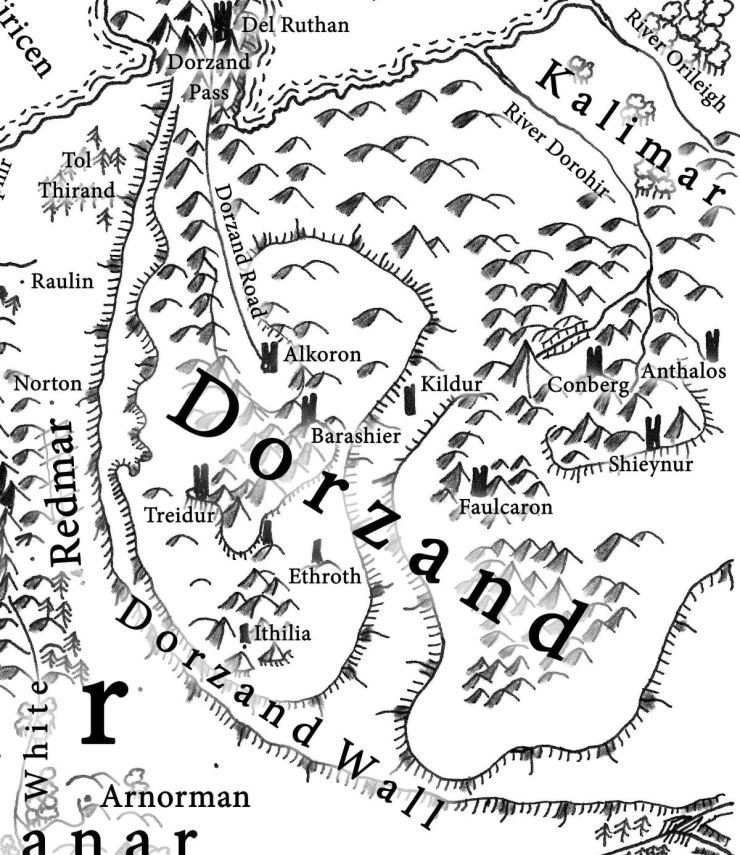
Dorzand is a high, mountainous plateau squeezed between Kalimar to the east, Aranar to the west and Ciricen to the north. It is not considered one of the great realms of Astrom, for it has never been a single, stable entity, but rather an ever-shifting patchwork of warring city-states and migratory tribes. Dorzand also has no single, uniting cultural heritage, for its rugged heights have been a melting pot of different ethnicities and societies. Elves, dwarves, Mortals, orcs, goblins and Rascai, all have left their mark on Dorzand.
Although often thought of as a homogenous mass and derided by the lowlanders of Aranar and Ciricen as just uncivilized barbarians, the inhabitants of Dorzand can actually be divided into several distinct tribes and groupings, with significant differences in their modes of living. These differences stem from the varied geography of Dorzand, but also from which races first settled in different areas. Dorzand is composed of two separate plateaus, Jarazand in the east and Cavazand in the west, both raised far higher than the surrounding countries and separated by a great rift valley running north to south between them.
History
The tribes of Jarazand have the oldest heritage, being the first to be settled by Snow-elven explorers in the depths of the First Chapter. Rúndel, Faulcaron, Anthalos, Shieynur and Rúmidoroen were all first established by the Snow-elves, roaming west out of Kalimar over the Black Mountains and into the rugged heights of eastern Dorzand. For millennia these were but small communities living in remote areas as part of a thin net of Elvendom stretching from the hilly shores of Beachbone Bay in the north to the great gorge of the River Vanri in the south. They dwelt mostly in contented isolation, having little to do with each other, and less with the lowland elven kingdoms far off.
In a later wave of migration, late in the First Chapter, some elves went further west. Those that did not leave Dorzand entirely for the warmer lowland climes of Aranar established new settlements in Cavazand, the western plateau. Of these, Barashier, Fandaez (later Treidur), Del Cavalmar and Ethroth were the most famous. Barashier was a graceful city built beside the cold waters of a glittering lake in a ring of hills; Fandaez perched at the end of a long thin spur of mountainside with high sheer cliffs on either side; and Del Cavalmar and Ethroth were built at opposing ends of a great evergreen forest, the largest wooded expanse on the plateau.
Things changed in the early Second Chapter when the Snow-elves discovered the Rascai in high caves on the mountainside. Although less well-known than the armists and dwarves dwelling to the south, the Rascai were in fact the third branch of the Children of the Mountains to awake in the Second Chapter. Their warren-like caves grew into a subterranean city called Qaşarg, but known to the elves as Conberg. The Snow-elves and Rascai dwelt in separates parts of Jarazand with cautious mutual respect, but a tragic series of encounters with a rogue elven mage led to the arising of the goblins, a twisted and hateful branch of the Rascai, and there was no peace between them and either the elves or the Rascai. Thus began the long wars of Dorzand, which never wholly ceased after this, and the elves began to fortify their dispersed settlements, while the goblins were driven underground or migrated west into the lowlands of Aranar, where they clashed with crusading orders of elven knights.
Of the elven cities in Jarazand, Anthalos was the furthest east and closest to Kalimar, standing atop a mighty flat-topped hill at the head of the Dorohir Valley. Shieynur was further south, perched atop a high ridge and commanding wide moorlands and mountain pastures that were sheltered from the worst weather by the imposing highlands to the north. Faulcaron lay much further west, enclosed in a range of precipitous mountains, and its folk were the most secretive and insular of the elven settlements in Dorzand. Rúnburg was situated at the northern edge of Jarazand, where the plateau began falling away to the north in long waves of descending hills. Rúmidoroen, although built in the great rift valley between the two plateaus, was still reckoned as belonging to Jarazand.
Dwarves, migrating out of Alanmar to the south, came to Dorzand in the mid-Second Chapter, and, finding the terrain and its rich veins of ore and minerals to their liking, began excavating many caves and halls across the wilderness. Their settlements spanned from the mighty cliffs of the Dorzand Wall in the west to the narrow, cloven vales of the Upper Dorohir. Although never as wealthy or renowned as their kin in Carthak further south, they were nevertheless craftsmen and builders of considerable skill, and while they maintained uneasy trade with the elves, they too clashed with the goblins, who were enemies of all.
The fate of Dorzand was forever changed by the Dawn of Mortality at the end of the Second Chapter, for despite its rugged and majestic isolation, it did not escape the rising tide of heresy that culminated in the Great Betrayal. Like their distant kin in other realms, elves across Dorzand forsook Prélan, their Creator, for the worship of demons, false gods or no deity at all. As a result, many of the elven settlements in Dorzand became mortal, forever estranged from their immortal kin who remained faithful to Prélan. Ever after, Dorzand was divided between these faithful elves and those who became mortal, and it was the Mortals who were far more numerous, the ancestors of great tribes.
In the east, Anthalos and Faulcaron remained the only bastions of Elvendom, with Rúndel, Shieynur and Rúmidoroen all becoming mortal. The names of both cities and tribes changed with the passing generations. The elven names Rúndur, Shieynur and Rúmidoroen became corrupted to Rúnburg, Hirhanor and Kildur respectively, and the mortal tribes centred on those cities became known as the Rúnoss, the Hirhoss and the Kildoss. Faulcaron remained elven for many centuries, but was eventually conquered by the mortal tribes, and its named changed to Darcron, controlled by the Daross tribe. Anthalos held out for much longer, the last elven outpost in Dorzand. And all the while, the goblins and dwarves fought underground, and the Rascai maintained their semi-hidden city of Qaşarg.
In the west, no elven settlements remained, all becoming mortal. Barashier became Uryath, Del Cavalmar became Dalanor, Ethroth became Etrovia and Fandaez became Treidur. The dialect of the western plateau had diverged from that of the east, and the tribes in these western cities came to be known as the Urgantes, the Dalvantes, the Ethrates and the Treidantes. The Urgantes controlled the northern part of the western plateau, the Treidantes the western reaches, and the Dalantes and Etrovetes existed in perpetual conflict for hegemony over the eastern and southern hills. All these mortal tribes and cities were hostile to each other, to the elves further east, to the dwarves who now rarely showed themselves above ground, and to the goblins who still plagued all parts of Dorzand, and so Dorzand became byword for lawless strife.
Into this bloody mix came new adventurers from outside. Mortals from Ciricen came south over the Dorzand Pass to found the cities of Alandur and Alkoron in northern Cavazand, where they fought the Urgantes and the Kildoss further east. These Ciricien settlers were ruthless warriors and became known as the Alandai and Alkordai. From the plains of Aranar came the ancestors of the Wolf Clan, who would dwell along the western margins of Cavazand for millennia, even gaining dominance over the Treidantes for long periods and their inaccessible citadel of Treidur. Much later, another wave of Aranese settlers, forced from their home in Esmarel, came to the southern hills of Cavazand, and founded the realm of Ithilia in a sheltered valley.
There was constant struggle between all these different tribes, races and principalities, with the fortunes of each waxing and waning over time, but eventually they were all overwhelmed by a wave of evil that rose towards the end of the second millennium of the Third Chapter. Kurundar, the sorcerer-king of Urunmar in the north, sought both to encompass the downfall of Ciricen and to establish a base for attacks against Kalimar. Seizing control of Dorzand allowed him to do both, and to this end he began working with diabolical tenacity. At first he merely exacerbated the existing tensions between the hill-tribes, weakening all of them, but he also armed and emboldened the goblins, and later reinforced them with hordes of orcs. At first these were few in number, marching overland through Ciricen, but their numbers grew exponentially until they were the dominant force in Dorzand. They were to a bane to elves, mortals, dwarves and Rascai alike. The dwarven halls were ruined and left nigh deserted, elven Anthalos was sacked after a long siege, and the Mortal tribes were either massacred or subdued under Kurundar’s yoke.
This sad state of affairs lasted throughout the last thousand years of the Third Chapter, and only ended after a holocaust of devastation at the end of the Second War of Kurundar. The orcs suffered severe losses in their failed invasion of Kalimar, and then were caught between vengeful elves and the armies of men and armists coming north to liberate Aranar and Ciricen. Finally, a dwarven crusade was launched from Carthak in the south to reclaim their lost Dorzandian homes, and between all these converging enemies, the orcs of Dorzand were annihilated. The Free Peoples suffered grievous losses in the process too, however. The elves went back to Kalimar, never to return, but keeping a watchful guard over the passes into Dorzand. The dwarves were crippled by the effort of their crusade, and few remained to dwell in the ancient halls that they had liberated with so much bloodshed. Above ground the Mortal tribes recovered and became independent again, though swiftly resuming their age-old patterns of quarrels and shifting alliances. This was the Dorzand that emerged into the Fourth Chapter, a wild land steeped in the blood of centuries and built on the bones of countless rival civilisations.
Political & society organisation
Mortal society in Dorzand was mostly tribal, made up of extended family units and kinship groups. Elders held great influence and chieftains were elected by communal gatherings to act as judges and lawgivers. Sometimes the smaller tribes would join together in larger confederations, but such entities were unstable and usually short-lived. Most of the time each tribe held its own lands and stayed put, but when put under pressure by hostile neighbours or bad harvests, they could become whole nations on the move, migrating towards better prospects. Invasions of the lowlands of Aranar were often triggered by such upheavals.
Some of the tribes were ruled by warlords or tyrant-kings who seized power by force and ruled by fear, but in such cases they tended to eschew the formal trappings of kingship seen elsewhere in Astrom, ruling through a tight-knit group of bonded followers rather than a stylized court or fixed bureaucracy. The Ciricien cities were ruled by more formal military elites, after the Lordai pattern, and were distinct from other Dorzandians for their higher levels of formality and organisation. At all levels of society, lordship was personal, based on sacred oaths and usually involving lifelong relationships of service in return for protection and reward. Most chieftains in Dorzand had a band of trained household warriors sworn to them, from the meanest steading chieftains with a handful of followers to the great lords with huge retinues of hundreds of warriors.
Religion
The Snow-elves and a few isolated groups of repentant Mortals clung to the worship of Prélan, albeit a quite mystical and rarefied form of the faith that would have been scarcely recognisable to the elves of Kalimar, but elsewhere in Dorzand the teachings of Prélan were abandoned and other forms of religion abounded. Some tribes fell into demon-worship and death cults, but most of the folk of Dorzand took local gods after their own likeness, fickle and capricious gods of sky, stone and snow. Each forest, lake and mountain had its own deity, while others were recognised across Dorzand with adherents in many different tribes. Dorzandian religion was quite informal and based on shared memories and oral traditions, rather than any fixed system or written text. These were shamanistic religions, with a penchant for sacrifice-rituals, ancestor reverence, communal storytelling and torchlit dances.
Fighting style & powers
The Dorzandian tribes were unsophisticated when it came to weaponry and unorganised in tactics and logistics. Armies tended to be small and led by household warriors, with larger hordes coalescing at times of need and then disbanding when the crisis had passed. Dorzandian warriors were fierce and brave but ill-disciplined, thirsting for the renown gained from personal combat and seeking glory in battle above all else. Good swords were rare and highly prized in Dorzand, so axes, spears and clubs were more usual weapons.
In a similar way, good armour was hard to come by – most of the best armour being pillaged from Aranar during raids – and so most fighters were protected by little more than hardened leather and thick woollen coats. The Ciriciens fought Lordai-style with mounted scouts and formidable shield walls, and the Snow-elves relied on surprise, concealment and long-range weapons, but most other Dorzandians fought as general infantry with little organisation. The Wolf Clan, with their Aranese heritage, were unusual for preferring to fight from horseback, riding tough breeds of horses adapted to life on the high plateau – and they were also usually better equipped and armoured than their more rustic neighbours, owing to their ability to trade with the other clans of Aranar and even distant Hendar.
Dwellings, diet & dress
Large cities were few and far between in Dorzand, and those that did exist were austere, strongly fortified and lacking many lowland amenities. They were utilitarian places of refuge and strongholds for controlling the surrounding wilderness. More common were village-sized fortified steadings and homesteads, where the clustered dwellings of a few families or clans relied on ditches and palisades for defence. The more migratory tribes lived in domed huts made of stretched and layered hides and possessed nothing that couldn’t be transported by mule-cart or on horseback. Other Dorzandians lived in caves, some quite small and rustic, others huge networks of underground villages that owed much to dwarven and Rascai influence. After the fall of the Snow-elven cities like Anthalos, their Mortal successors continued to live in a series of dilapidated towers that criss-crossed the jagged, mountainous landscape.
Agriculture was sporadic and precarious in Dorzand. Barley could be grown in some warmer, more sheltered valleys, but rye and oats were more common, while root vegetables and berries formed a more important part of the diet than legumes or orchard fruits. Many tribes were partially or wholly dependent on what could be produced by their huge herds of sturdy cold-resistant animals like yaks, elk and ibex: milk, cheese, meat, hides and horn. The people of Dorzand lived in a constant battle against the elements, with cool summers and extremely harsh winters, and they dressed accordingly in many layers of thick wool and fur skinned from many animals.
To read the best exclusive content from World of Astrom, please subscribe to World of Astrom on Patreon today. In return for a small monthly fee, you can access my full-length unpublished novel drafts, hi-res maps and other bonus features.
Photo by Romain Briaux on Unsplash
 World of Astrom
3 thoughts on “Races of Astrom: Mortals of Dorzand”
Comments are closed.