Welcome back to the World of Astrom blog! Here I’m continuing my Races of Astrom series with a sequence of posts about the different Mortal people groups in Astrom. This follows on from previous posts about the elves, dwarves and armists.
***
After the recent introduction to the Mortals in Astrom generally, and these portraits of the Mortals of Aranar, the Mortals of Ciricien, the Mortals of Hendar, the Mortals of Lurallan, the Mortals of Dorzand, the Mortals of Urunmar and the Mortals of Firwood, this is the eighth and final part in a series of posts looking at each race of Mortals in turn. I hope you’ve enjoyed the series, and do go back and read any you missed.
Swordhilt Peninsula, or Rincen, is the name given to a huge promontory of land on the eastern coast of Astrom. It extends eastward from Maristonia, with long spurs thrust north into Nimrell Bay and south beyond Dagger’s Cove, and a long sweep of Troizon coastline in-between.
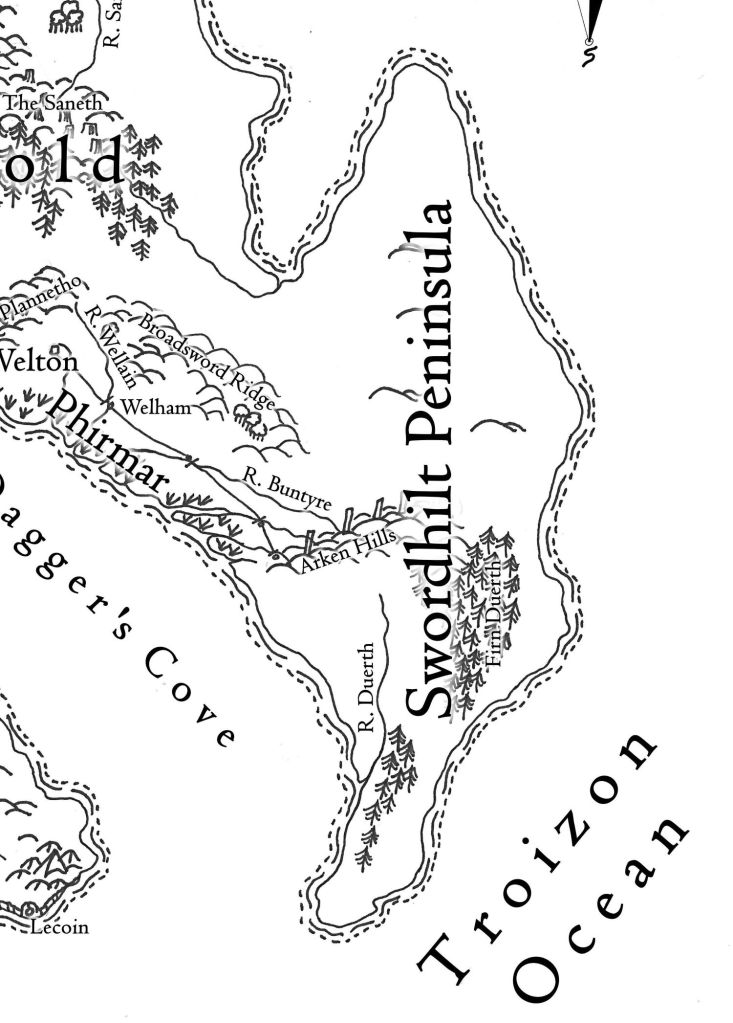
Its precise borders are hard to discern, having never been definitively fixed. With the ebb and flow of history they have changed, sometimes sweeping as far inland as the Armist Road and the borders of Kalimar, and at other times hugging close to the barest coastal strip when Maristonian power was exerted to its utmost. Broadly speaking, the line of the Arken Hills marked the easternmost frontier of Maristonia, but where these hills petered out to the north the border was less clear. A great forest, called Firn Duerth, wrapped around the feet of the Arken Hills in the south of the peninsula, but elsewhere the land was defined by low hills, scrub forest and heathland. Its coastline was mostly long, windswept beaches edged by tall dunes, interspersed with some rocky headlands and large swathes of marsh and tidal creeks. It was a poor land lacking in fertile soils and incapable of supporting a large population.
Its first inhabitants were roaming elves migrating east out of the ancient Kingdom of Alanmar. An enclave of Sea-elves held sway in the hill-surrounded wetlands of Phirmar, but other elves wandered beyond the hills to settle in the hills, woods and fens of Swordhilt Peninsula. These were mostly Sea-elves and Wood-elves, with very few Avatar, and the two kindreds stayed separate for the most part, adopting the long coasts and the inland forests respectively as their domains. Neither group had much contact with the outside world, beyond limited trade with the Sea-elves of Phirmar. They were mostly forgotten by the King of Alanmar and the merchant-princes in their great cities that lay on the road between Alanmar and Kalimar.
Like so many other elves across the continent, most of the inhabitants of Swordhilt Peninsula abandoned their belief in Prélan over the course of the Second Chapter and succumbed to mortality as a result. Although their kin further west mostly escaped this fate, the power of Alanmar was broken by the cataclysm of the Carthaki Wars, and the new armist kingdom of Maristonia that arose from the ashes shrank back to a fraction of Alanmar’s greatest extent, with the result that outlying peoples like those on Swordhilt Peninsula were forgotten and ignored for long centuries.
By the second millennium of the Third Chapter, Maristonian power was growing, and it began to swallow up a lot of the debatable land in the east. This brought the independent Mortal tribes of Swordhilt Peninsula into conflict with their more powerful armist neighbours, and this conflict never wholly ceased thereafter. For most of the Third Chapter, the kings of Maristonia were content to hold the line of the Arken Hills and ignore what lay beyond, but at times they pressed further east to the coast, oppressing and subjugating the Swordhilt tribes. Those tribes responded with fierce opposition, sabotaging Maristonian outposts and harassing military patrols with guerilla warfare; even in times of peace they rarely went long without raiding into the East-fold to steal plunder and cattle.
The deep-notched coves and shifting tidal creeks proved ideal places for Alanai corsairs to hide their ships and use as bases for attacks on eastern Maristonia, and this would provoke intermittent campaigns by armist warships to flush the raiders out and safeguard their coastal cities and shipping routes. The folk of Swordhilt Peninsula themselves were not pirates however, and even those dwelling on the shores rarely went to sea except to make short trips up and down the coast.
To Maristonia, the Mortals of Swordhilt Peninsula were merely barbarians, wild, lawless savages existing on the edges of their knowledge. Most armists forgot that those tribes had elven heritage, if they ever knew it to begin with. Yet the Rincenai were a proud people, mindful of their Wood-elven and Sea-elven ancestry and fiercely protective of their way of life. They did not dwell in cities or construct bridges and roads, and they had no formal economy. Many of them were hunter-gatherers or fishermen, and the different kinship clans among them traded with each other for what they needed. During times of Maristonian occupation there was limited trade with the armists, but most of the time the Rincenai refused all contact with armist civilisation.
The Rincenai had chieftains, elders and seers rather than kings, nobles and priests. They had long since abandoned elven religion and now practiced their own ritualistic customs, worshipping ancestor spirits or gods of sea, sky and forest. They lived in woodland steadings, coastal caves or villages built on stilts and platforms amid the marshes, and wore traditional clothing made from natural fibres and animal hides. Except for a few heirlooms inherited from elven days, most of their tools and utensils were made of wood, bone and stone, but later they re-learnt basic metal-working from armist occupiers, after which they prized weapons of bronze and ornaments of gold. Some of the inland tribes favoured the colour red, and red-feathered arrows were a symbol of fear and cruelty among the armists of eastern Maristonia, but elsewhere in Swordhilt Peninsula there were many other fashions and styles.
To read the best exclusive content from World of Astrom, please subscribe to World of Astrom on Patreon today. In return for a small monthly fee, you can access my full-length unpublished novel drafts, hi-res maps and other bonus features.
Photo by CURTIS HYSTAD on Unsplash
 World of Astrom